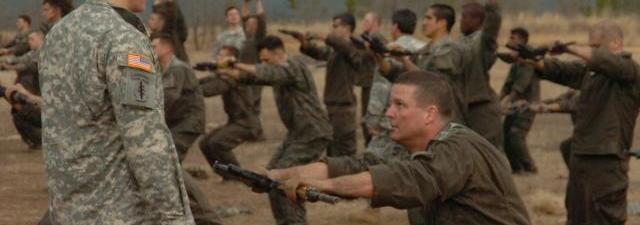
Military Executives: Linking Internal & Orthopaedic Conditions with Physical Fitness

Research Paper Title An evaluation of the significance of individual endogenous risk factors and medical and orthopaedic conditions on physical fitness in military executives. Background As part of occupational health promotion in the Bundeswehr (military services of the Federal Republic of Germany), top-ranking executives were offered a medical examination and training programme. The participants were… Read More

Capita Misses Savings Targets for UK Armed Forces Recruitment

Capita, a FTSE 25 company and the outsourcing provider for UK armed forces recruitment, has been repeatedly missing government savings targets on its contract to recruit soldiers to the British army. Over the last six years, Capita has delivered just £2.73 million of savings against a Ministry of Defence target of £104.3 million. Reference Bond, D. (2018) UK… Read More

Leishmaniasis & Personal Protection in the Colombian Armed Forces

Research Paper Title Leishmaniasis: Who Uses Personal Protection among Military Personnel in Colombia? Background Leishmaniasis is common in Colombia, negatively affecting the health of military personnel active in endemic areas. The disease is transmitted by sand fly bites. Therefore, during duty, use of long-sleeved uniforms and other clothes treated with permethrin and application of mosquito… Read More

Planning & Branches…

“Every plan of campaign ought to have several branches and to have been so well thought out that one or other of the said branches cannot fail of success.” Pierre-Joseph de Bourcet (1700-1780) A French engineer and artillery officer who has been credited with initiating the use of the all-arms division as a tactical formation… Read More

Number of Students on the RLC Movement Controller Courses, 2007-2015

Tables 1 and 2 outline the number of students on the Royal Logistics Corps (RLC) movement controller class 1 and class 2 courses for the period 2007 to 2015. Table 1: RLC movement controller class 1 Training Year Number of Attendees Number Passed 2007/2008 25 20 2008/2009 15 15 2009/2010 15 15 2010/2011 15 15… Read More

Developing Screening Methods to Augment Injury-prevention Programmes in US Army Special Forces

Research Paper Title Physical and Performance Characteristics Related to Unintentional Musculoskeletal Injury in Special Forces Operators: A Prospective Analysis. Background Seventy-seven percent of musculoskeletal injuries sustained by United States Army Special Forces Operators are preventable. Identification of predictive characteristics will promote the development of screening methods to augment injury-prevention programmes. The objective of the research… Read More

Disease & Non-Battle Traumatic Injuries in US Military Personnel

Research Paper Title Disease and Non-Battle Traumatic Injuries Evaluated by Emergency Physicians in a US Tertiary Combat Hospital. Background Analysis of injuries during military operations has focused on those related to combat. Non-combat complaints have received less attention, despite the need for many troops to be evacuated for non-battle illnesses in Iraq. This study aims… Read More