
“Strategy without tactics is the slowest route to victory. Tactics without strategy is the noise before defeat.” Sun Tzu, circa 500 B.C.
“Strategy without tactics is the slowest route to victory. Tactics without strategy is the noise before defeat.” Sun Tzu, circa 500 B.C.

“Take calculated risks. That is quite different than being rash.” George S. Patton (WWII US General, 1885-1945)

Research Paper Title Historical Reflection on Learning Theories and Instructional Design. Abstract Employing his research and practical experience in the field of educational psychology, with a specialty in instructional design and technology, Robert Tennyson (University of Minnesota, USA) reflects on the theoretical foundations of instructional design. Tennyson’s purpose is to show the growth of the… Read More

Research Paper Title Human Factors Guidance for Designers of Interactive 3D and Games-Based Training Systems. Background This is the second edition of the Human Factors (HF) Guidelines for Interactive 3D (i3D) and Games-Based Training Systems Design, published in 2012 (1st Edition published in 2008). The author states the motivation for publishing such a document came about due to a realisation that technology… Read More

“The most formidable warriors are students of their profession.” General Al Gray, (29th Commandant of the US Marine Corps, 1987-1991).
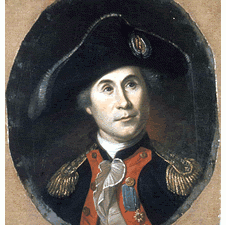
“Whoever can surprise well must conquer.” John Paul Jones (Naval Commander, American Revolutionary War, 1747-1792) Read more about John Paul Jones at: http://www.nps.gov/revwar/about_the_revolution/jp_jones.html

Research Paper Title Human Behaviour in Military Contexts. Outline of Report People are the heart of all military efforts. People operate the available weaponry and technology, and they constitute a complex military system composed of teams and groups at multiple levels. Scientific research on human behaviour is crucial to the military because it provides knowledge about how people… Read More


