Who was Bud Day?

Introduction George Everette “Bud” Day (24 February 1925 to 27 July 2013) was a United States Air Force officer, aviator, and veteran of World War II, Korean War and Vietnam War. He was also a prisoner of war, and recipient of the Medal of Honour and Air Force Cross. As of 2016, he is the… Read More
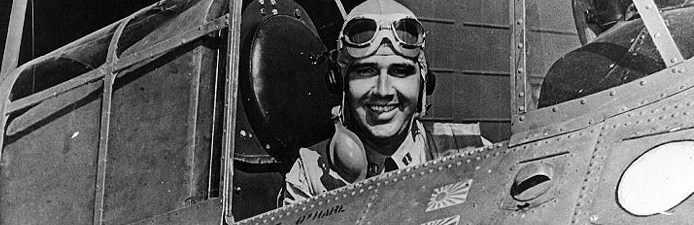
Who was Walter D. Ehlers?

Introduction Walter David Ehlers (07 May 1921 to 20 February 2014) was a United States Army soldier and a recipient of the US armed forces’ highest decoration, the Medal of Honour, for his actions in World War II. Early Life Ehlers was born on 07 May 1921, in Junction City, Kansas. Military Service Ehlers joined… Read More

Who was Edward O’Hare?

Introduction Lieutenant Commander Edward Henry O’Hare (13 March 1914 to 26 November 1943) was an American naval aviator of the United States Navy, who on 20 February 1942, became the Navy’s first fighter ace of the war when he single-handedly attacked a formation of nine heavy bombers approaching his aircraft carrier. Even though he had… Read More

Who was Eugene Esmonde?

Introduction Lieutenant Commander Eugene Esmonde, VC, DSO (01 March 1909 to 12 February 1942) was a distinguished Irish pilot in the Fleet Air Arm who was a posthumous recipient of the Victoria Cross (VC), the highest award for gallantry in the face of the enemy awarded to members of Commonwealth forces. Esmonde earned this award… Read More

Who was Douglas MacArthur?

Introduction Douglas MacArthur (26 January 1880 to 05 April 1964) was an American military leader who served as General of the Army for the United States, as well as a Field Marshal to the Philippine Army. He was Chief of Staff of the United States Army during the 1930s, and he played a prominent role… Read More

What was the Royal Air Force Mutiny of 1946?

Introduction The Royal Air Force Mutiny of 1946 was a series of demonstrations and strikes at several dozen Royal Air Force stations in the Indian Subcontinent in January 1946. Background As these incidents involved refusals to obey orders they technically constituted a form of “mutiny”. The protests arose from slow demobilisation and poor conditions of… Read More

What was the G.I. Bill (1944)?

Introduction The Servicemen’s Readjustment Act of 1944, commonly known as the G.I. Bill, was a law that provided a range of benefits for some of the returning World War II veterans (commonly referred to as G.I.s). The original G.I. Bill expired in 1956, but the term “G.I. Bill” is still used to refer to programmes… Read More