The Biomechanics of Standing Calf Raises

The standing calf raise is a common resistance exercise for strengthening the plantar flexors that act at the ankle joint (i.e., gastrocnemius, soleus). Calf raises are a method of exercising the gastrocnemius, tibialis posterior and soleus muscles of the lower leg. The movement performed is plantar flexion, aka ankle extension. Improper form while performing this… Read More
The Biomechanics of Lifting & Carrying Objects

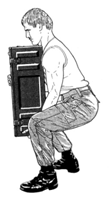
Common advice for individuals lifting objects from a standing position includes “keep the back straight” and “lift with the legs.” As a fitness professional, what if your client was to ask for an explanation of this advice? Is this advice correct from a biomechanical perspective? Figure A shows an incorrect method of lifting an object… Read More

What Causes the ‘Sticking Point’ During a Lift?

Let’s imagine a woman is performing a common bicep curl with a barbell. After several repetitions of the exercise, she notices that the barbell seems to be heavier, and the exercise more difficult at the 90° elbow angle position than at any other position in the ROM (range of motion). She has heard the term… Read More

How Many Calories Does A Burpee Burn?

Burpees and Energy Expenditure The amount of energy expended (or calories burned per minute) varies according to: Your weight: The amount of calories burned by your body does not depend on your weight alone, since a higher bodyweight requires (relatively) more energy expenditure to move. Intensity of physical activity/exercise. Your metabolism. Your level of physical… Read More

How Many Calories Does a Press-up (Push-Up) Burn?

Introduction Estimates of exactly how many calories a single press-up (or push-up) burns vary somewhat, from about 0.29 calories to 0.36 calories per press-up, depending on the research you cite (Cohen, 2012; McCall, 2017). However, a 2014 study from researchers at Arizona State University (Vezina et al., 2014) (and based on an earlier thesis by… Read More

Need Oxygen to Breath: Convert Carbohydrates into Alcohol!

“GOLDFISH and their wild crucian carp relatives can survive for five months without breathing oxygen – and now we know how. The fish carry a set of enzymes that, when oxygen levels drop, helps convert carbohydrates into alcohol that can be released through the gills. For most animals, including humans, a lack of oxygen can be fatal in… Read More

Are You A Non-Responder?

In 2012, Doctor Michael Mosley undertook a form of interval training, that came to be known as the Timmons Regime, as part of a BBC documentary ‘Horizon: The Truth About Exercise’ (Mosley, 2012). Jamie Timmons, professor of ageing biology at the University of Birmingham, is a proponent of a few short bursts of flat-out intensity.… Read More