What is Deconditioning?

Introduction Deconditioning is adaptation of an organism to less demanding environment, or, alternatively, the decrease of physiological adaptation to normal conditions. Outline Deconditioning can result from decreased physical activity, prescribed bed rest, orthopaedic casting, paralysis, ageing. A particular interest in the study of deconditioning is in aerospace medicine, to diagnose, fight, and prevent adverse effects… Read More


What is a Stretch Shortening Cycle?

Introduction A stretch-shortening cycle (SSC) is an active stretch (eccentric contraction) of a muscle followed by an immediate shortening (concentric contraction) of that same muscle. Research Studies The increased performance benefit associated with muscle contractions that take place during SSCs has been the focus of much research in order to determine the true nature of… Read More

What is Athletic Heart Syndrome?

Introduction Athletic heart syndrome (AHS) is a non-pathological condition commonly seen in sports medicine in which the human heart is enlarged, and the resting heart rate is lower than normal. The athlete’s heart is associated with physiological cardiac remodelling as a consequence of repetitive cardiac loading. Athlete’s heart is common in athletes who routinely exercise… Read More

What is Muscle Hypertrophy

Introduction Muscle hypertrophy or muscle building involves a hypertrophy or increase in size of skeletal muscle through a growth in size of its component cells. Two factors contribute to hypertrophy: sarcoplasmic hypertrophy, which focuses more on increased muscle glycogen storage; and myofibrillar hypertrophy, which focuses more on increased myofibril size. It is the primary focus… Read More

What is Muscle Atrophy?

Introduction Muscle atrophy is the loss of skeletal muscle mass. It can be caused by immobility, ageing, malnutrition, medications, or a wide range of injuries or diseases that impact the musculoskeletal or nervous system. Muscle atrophy leads to muscle weakness and causes disability. Disuse causes rapid muscle atrophy and often occurs during injury or illness… Read More

What is Sports Science?

Introduction Sports science is a discipline that studies how the healthy human body works during exercise, and how sports and physical activity promote health and performance from cellular to whole body perspectives. The study of sports science traditionally incorporates areas of physiology (exercise physiology), psychology (sport psychology), anatomy, biomechanics (sports biomechanics), biochemistry, and kinesiology. Sport… Read More

What is Supercompensation?

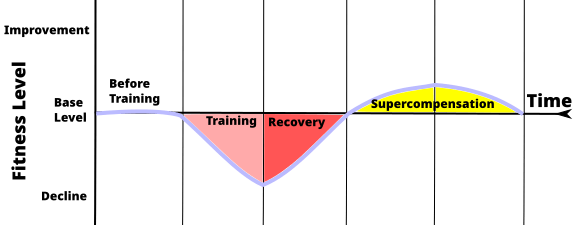
Introduction In sports science theory, supercompensation refers to the post-training period during which the trained parameter has a higher performance capacity than it did prior to the training period. Refer to Exercise & Training as Stressors. Description The adaptation of the load is termed supercompensation. First put forth by Russian scientist Nikolai N. Yakovlev in… Read More