
This article is sponsored by Remployee.
Introduction
The US Army signed more than 61,500 future Soldiers for fiscal year 2026, and many of them are likely to hit the same wall in week one: a brand-new language.
Drill sergeants fire off acronyms, radio traffic sounds like code, and answering a superior can feel like a test with no study guide. Civilian habits can also backfire.
Rambling answers, guessing instead of asking and casual phone use can cost you credibility or, in the field, much more. Throw in military slang and the learning curve gets steep fast.
This guide covers the basics, from the phonetic alphabet to radio etiquette and OPSEC (operational security), so you can show up sounding sharp instead of lost.
Why Clear Communication Matters
In the military, a garbled message can mean a missed objective or a lost life. One of the clearest lessons comes from aviation. In 1977, two Boeing 747s collided on a fog-covered runway in Tenerife after a KLM crew began its takeoff without clearance.
Vague phrases like “we are now at takeoff” left the meaning unclear, and overlapping calls on a shared frequency added to the confusion. Investigators later stressed the importance of standard terminology in every radio call.
Military radio procedure follows the same logic. For a new recruit, clear communication can:
- Keep your squad safe during training and real operations (you shoot at the enemy rather than friendlies (known as blue on blue));
- Save time when every second counts; and
- Build trust with your leaders and battle buddies.
Good communication is a skill you can train, just like push-ups (press-up).
Master the Phonetic Alphabet and Military Time
Two tools provide simple but effective help: the phonetic alphabet and the 24-hour clock. Over a radio, letters like M and N can sound nearly identical. Saying “Mike” or “November” removes the guesswork.
Military time works the same way. There is no a.m. or p.m. to mix up. 1800 always means 6.00 p.m. and 0600 always means 6.00 a.m.
A few, helpful, ways to drill both before you ship:
- Spell your name, street and license plate phonetically out loud;
- Switch your phone clock to 24-hour format; and
- Quiz a friend with random letter combos.
With a few minutes of daily practice, these can become second nature before reception week ends.
Learning Army Acronyms and Slang
The military runs on acronyms. From your first day of training you will hear terms like DFAC, PT, MOS and AIT tossed around like common knowledge. Slang adds another layer of communication to learn and master. Some common examples include:
- Hooah: an all-purpose word for “understood,” “yes” or “let’s go”.
- Battle buddy: the partner assigned to you for nearly every task.
- Fobbit: a soldier who rarely leaves the base.
- Embrace the suck: accept the misery and keep moving.
Battle buddies are a big deal. For example, at Fort Leonard Wood in 2026, trainees were paired with one on Day Zero for everything from filling hydration sources to tracking down paperwork.
So what should you do when you do not know a term? Ask. Guessing can create more problems than admitting you are unsure, and many drill sergeants would rather hear a quick question than fix a mistake later.
Radio Basics for First-Timers
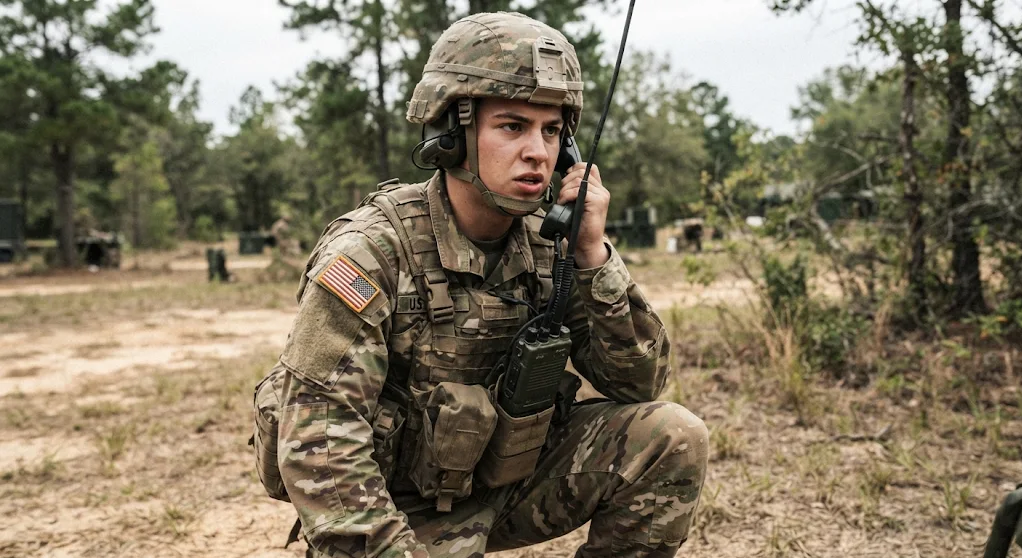
Radio training can start sooner than many recruits expect. In October 2026, trainees at Fort Leonard Wood sat through a Basic Military Communications course and got hands-on time with a man-pack radio used for medevac requests, spot reports and situation reports. One private called the gear “walkie-talkies on steroids.”
Militaries worldwide keep investing in this gear. The military tactical radio market is projected to reach $6.15 billion in 2026.
The core habits stay the same on any device:
- Think before you key the mic;
- Press, pause a beat, then speak;
- Keep it short, and never say “over” and “out” together (they mean different things).
Civilian push-to-talk gear follows similar rules. Some security teams and work crews use LTE radios from companies like Peak PTT, which run on cellular networks instead of repeaters. Using one before you ship can give you early reps.
Speaking Up the Chain of Command
Talking to leaders follows its own rules, and new recruits often trip over them. Your drill sergeants shape many of your habits in basic combat training (BCT), from how you eat to how you speak, so watch how they expect to be addressed and copy it.
A few basics that can keep you out of trouble:
- Address drill sergeants as “Drill Sergeant,” never “sir” or “ma’am”;
- Answer direct questions with “Yes, Drill Sergeant” or “No, Drill Sergeant”;
- Lead with your bottom line, then add details if asked; and
- Repeat instructions back when a task is complex.
Non-verbal signals count as well. Standing straight, making eye contact and keeping a steady tone can say as much as your words.
Want a simple test? If your answer runs longer than a few breaths, it can probably be shorter.
Phone Discipline and OPSEC
Operations security, or OPSEC, means protecting information an adversary could use against you. For a recruit, that starts with your phone and social media.
In 2018, the fitness app Strava published a global heatmap of user activity. Analysts soon spotted the outlines of U.S. military bases on it, traced by service members logging their daily runs. The Pentagon reviewed its GPS policies soon after. For fitness-minded recruits, that case hits close to home.
Threats can also come through your feed. Foreign actors can use fake accounts and impersonation to target troops, as covered in this look at online disinformation.
Smart habits include:
- Never posting training locations, schedules or unit movements;
- Checking photo backgrounds before sharing; and
- Treating unknown friend requests and DMs with suspicion.
If you wouldn’t say it over an open radio, keep it off the internet.
Staying Clear Under Pressure
Communication tends to fall apart when stress spikes. Your heart pounds and words come out jumbled. Basic training is built to create that pressure, and managing training stress can matter as much as your run time.
A few techniques can help you stay sharp:
- Box breathing: inhale, hold, exhale and hold for equal counts before you speak;
- Slow down: fast talkers on the radio often have to repeat themselves;
- Use a format: reports like SALUTE (size, activity, location, unit, time, equipment) give your brain a script to follow; and
- Rehearse: run through likely messages in your head before you key up.
Drill sergeants often add noise and urgency on purpose, so treat every shouted instruction as practice. If you can stay calm and clear while someone is yelling, you can be far more useful when it counts. The purpose is, partially, to simulate the stress witnessed on the battlefield.
Your First Radio Check Starts Before You Ship
Strong communicators tend to stand out early in basic training. They spell clearly, answer with the bottom line, keep their phones put away and ask when they do not know something. None of it requires talent, only repetition.
Summary
You can get a head start right now. Learn the phonetic alphabet, switch to military time, read up on common slang and practice short, clear answers with friends or family. Get comfortable speaking under a bit of pressure, too.
The recruits who prepare this way often settle in faster, earn trust sooner and make fewer avoidable mistakes. Show up ready to listen, speak with purpose and keep every transmission clean, and you can give yourself a real advantage from Day Zero.


