
Introduction
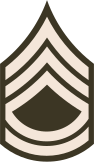
Sergeant First Class (SFC) is the seventh enlisted rank (E-7, NATO OR-7) in the US Army, ranking above staff sergeant (E-6, NATO OR-6) and below master sergeant and first sergeant (E-8, NATO OR-8), and is the first non-commissioned officer rank designated as a senior non-commissioned officer (SNCO).
A US Army SFC is equivalent to a British Army Staff Sergeant, as both are NATO OR-7.
Background
A sergeant first class is typically assigned as a platoon sergeant at the company level or battalion operations non-commissioned officer in charge at the battalion level, but may also hold other positions depending on the type of unit. In a combat arms role, a sergeant first class is typically second in charge (under an officer, typically a second lieutenant, serving as the platoon leader) of from 14 soldiers and four tanks in an armour platoon to 36 soldiers and four squads in a rifle platoon. A sergeant first class’s primary responsibilities are tactical logistics, tactical casualty evacuations, and serving as the senior tactical adviser to the platoon leader. Sergeant first class replaced the rank of technical sergeant in 1948. (However, the US Air Force, which separated from the Army in 1947, retained the rank of technical sergeant and the US Marine Corps had the rank of technical sergeant until 1959.)
A sergeant first class is addressed as “sergeant” except in certain situations, such as field artillery units, in which a sergeant first class serving as platoon sergeant is commonly referred to as “Smoke.” If a sergeant first class is appointed to fill the role of first sergeant, he or she is addressed as “First Sergeant.” Typically a sergeant first class assigned on a manning document to fill a first sergeant role while being promotable to master sergeant can be frocked to first sergeant rank and hold the insignia due its position.
Sergeant first class is the first enlisted rank in the US Army to be selected by the centralized promotion system. As such, it is considerably more difficult to achieve than the previous ranks. A sergeant first class is the first enlisted rank to be considered a SNCO, and a soldier achieving the rank gains not only prestige, but several benefits due to the position. Contrary to popular belief due to a common apocryphal saying, it does not take an act of Congress to reduce a sergeant first class in rank. The reduction authority from sergeant first class to staff sergeant is reserved for Commanders of organisations authorised a commander in the rank of colonel or higher. For separate detachments or companies, the reduction authority will be the next higher headquarters within the chain of command. The higher headquarters must be authorised by a commander in the rank of colonel or higher.
The rank title of sergeant first class (SFC) existed in the Army from 1890 until 1920 when it was eliminated in an army-wide simplification of enlisted ranks which had grown into a system containing 128 different rank insignia. The rank of SFC was used in several technical branches such as the Army Medical Department and in the Ordnance, Signal, and Quartermaster Corps and was equivalent to the field service ranks at the company/battery/troop “staff” NCO level, such as colour sergeant, supply sergeant, or radio sergeant. The Army restored the rank of SFC in 1948 when it replaced technical sergeant.
This page is based on the copyrighted Wikipedia article < https://en.wikipedia.org/wiki/Sergeant_first_class >; it is used under the Creative Commons Attribution-ShareAlike 3.0 Unported License (CC-BY-SA). You may redistribute it, verbatim or modified, providing that you comply with the terms of the CC-BY-SA.


