
Introduction
John Buchan, 1st Baron Tweedsmuir GCMG GCVO CH PC DL (/ˈbʌxən/; 26 August 1875 – 11 February 1940) was a Scottish novelist, historian, and Unionist politician who served as Governor General of Canada, the 15th since Canadian Confederation.

As a youth, Buchan began writing poetry and prose, fiction and non-fiction, publishing his first novel in 1895 and ultimately writing over a hundred books of which the best known is The Thirty-Nine Steps. After attending Glasgow and Oxford universities, he practised as a barrister. In 1901, he served as a private secretary to Lord Milner in southern Africa towards the end of the Boer War. He returned to England in 1903, continued as a barrister and journalist. He left the Bar when he joined Thomas Nelson and Sons publishers in 1907. During the First World War, he was, among other activities, Director of Information in 1917 and later Head of Intelligence at the newly-formed Ministry of Information. He was elected Member of Parliament for the Combined Scottish Universities in 1927.
In 1935, King George V, on the advice of Canadian Prime Minister R. B. Bennett, appointed Buchan to succeed the Earl of Bessborough as Governor General of Canada and two months later raised him to the peerage as 1st Baron Tweedsmuir. He occupied the post until his death in 1940. Buchan promoted Canadian unity and helped strengthen the sovereignty of Canada constitutionally and culturally. He received a state funeral in Canada before his ashes were returned to the United Kingdom.
World War I and the Thirty Nine Steps
With the outbreak of the First World War, Buchan began writing a history of the war for Nelson’s, the publishers, which was to extend to 24 volumes by the end of the war. He worked in the Foreign Office, and for a time was a war correspondent in France for The Times in 1915. In that same year, his most famous novel, The Thirty-Nine Steps, a spy-thriller set just prior to the First World War, was published. The novel featured Buchan’s oft-used hero, Richard Hannay, whose character was partly based on Edmund Ironside, a friend of Buchan from his days in South Africa. A sequel, Greenmantle, came the following year. In June 1916 Buchan was sent out to the Western Front to be attached to the British Army’s General Headquarters Intelligence Section, to assist with drafting official communiques for the press. On arrival he received a field-commission as a second lieutenant in the Intelligence Corps.
Recognised for his abilities, the War Cabinet, under David Lloyd George, appointed him Director of Information in 1917, essentially leading Britain’s propaganda effort. In early 1918, Buchan was made head of a Department of Intelligence within a new Ministry of Information under Lord Beaverbrook. Throughout the war, he continued writing volumes of the History of the War. It was difficult for him, given his close connections to many of Britain’s military leaders, not to mention the government, to be critical of the British Army’s conduct during the conflict but nonetheless did so in certain instances, being critical of government, politics or statements, or disagreeing with statistics. Buchan could enter comment on political events. He complimented Winston Churchill’s “services to the nation at the outbreak of war for which his countrymen can never be sufficiently grateful … but he was usually selected to be blamed for decisions for which his colleagues were not less responsible.”
Following the close of the war, Buchan turned his attention to writing on historical subjects, along with his usual thrillers and novels.
In 1935, Buchan’s literary work was adapted for the cinema with the release of Alfred Hitchcock’s The 39 Steps, starring Robert Donat as Richard Hannay, although Buchan’s story was much altered.
World War II
Buchan’s experiences during the First World War made him averse to war, and he tried to help prevent another one in co-ordination with Mackenzie King and the US President Franklin D. Roosevelt by the calling of a conference, to be chaired by the US and to include the European dictators. Those efforts to try to secure future peace and stability proved fruitless because the British Prime Minister, Neville Chamberlain, refused to countenance the idea.
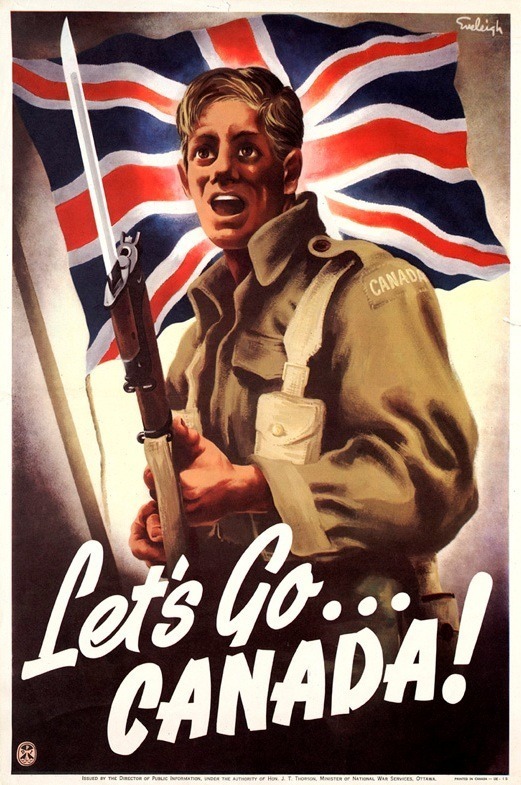
Tweedsmuir signed Canada’s declaration of war against Germany on 10 September, a week after the British declaration of war. The week difference allowed war-related materiel, such as aeroplanes and munitions, to move to Canada from the neutral United States, which was prohibited under the Neutrality Act from exporting such materiel to belligerents. During the fall of 1939, negotiations were held to establish an air training plan in Canada for Commonwealth air crew. The negotiations were long and difficult, in particular with Canadian Prime Minister Mackenzie King who was adamant that the facilities would be under the control of the Canadian government. Tweedsmuir had known from previous experience with a British mission, which had examined the possibility of aircraft production in Canada in the spring of 1938, that officials in Britain “do not seem to understand the real delicacy of the position of the self-governing Dominions, especially Canada. King had been difficult, as Chamberlain admitted to Tweedsmuir. Tweedsmuir played a key role in securing British agreement to the final negotiations in mid-December 1939 and King acknowledged this in a letter, thank the Governor General “warmly for the help … What a mischief there would have been had there been another moment’s delay!”
On 06 February 1940, he suffered a slight stroke and struck his head on the edge of a bath at Rideau Hall. Two surgeries by Doctor Wilder Penfield of the Montreal Neurological Institute were insufficient to save him, and his death on 11 February saw an outpouring of grief, gratitude and admiration, not only in Canada but throughout the English-speaking world. In a radio eulogy, Mackenzie King stated: “In the passing of His Excellency, the people of Canada have lost one of the greatest and most revered of their Governors General, and a friend who, from the day of his arrival in this country, dedicated his life to their service.” The Governor General had formed a strong bond with his prime minister, even if it may have been built more on political admiration than friendship: Mackenzie King appreciated Buchan’s “sterling rectitude and disinterested purpose.”
After lying in state in the Senate chamber on Parliament Hill, Buchan was given a state funeral at St Andrew’s Presbyterian Church in Ottawa. His ashes were returned to the UK aboard the cruiser HMS Orion for final burial at Elsfield, the village where he lived in Oxfordshire. In the United Kingdom, a memorial service was held in medieval Elsfield church on the Saturday after his death and services were held later that month at Westminster Abbey and at St. Giles Cathedral in Edinburgh.


 Boot Camp & Military Fitness Institute