
Introduction
In the United States, state defence forces (SDFs) are military units that operate under the sole authority of a state government. SDFs are authorised by state and federal law and are under the command of the governor of each state.
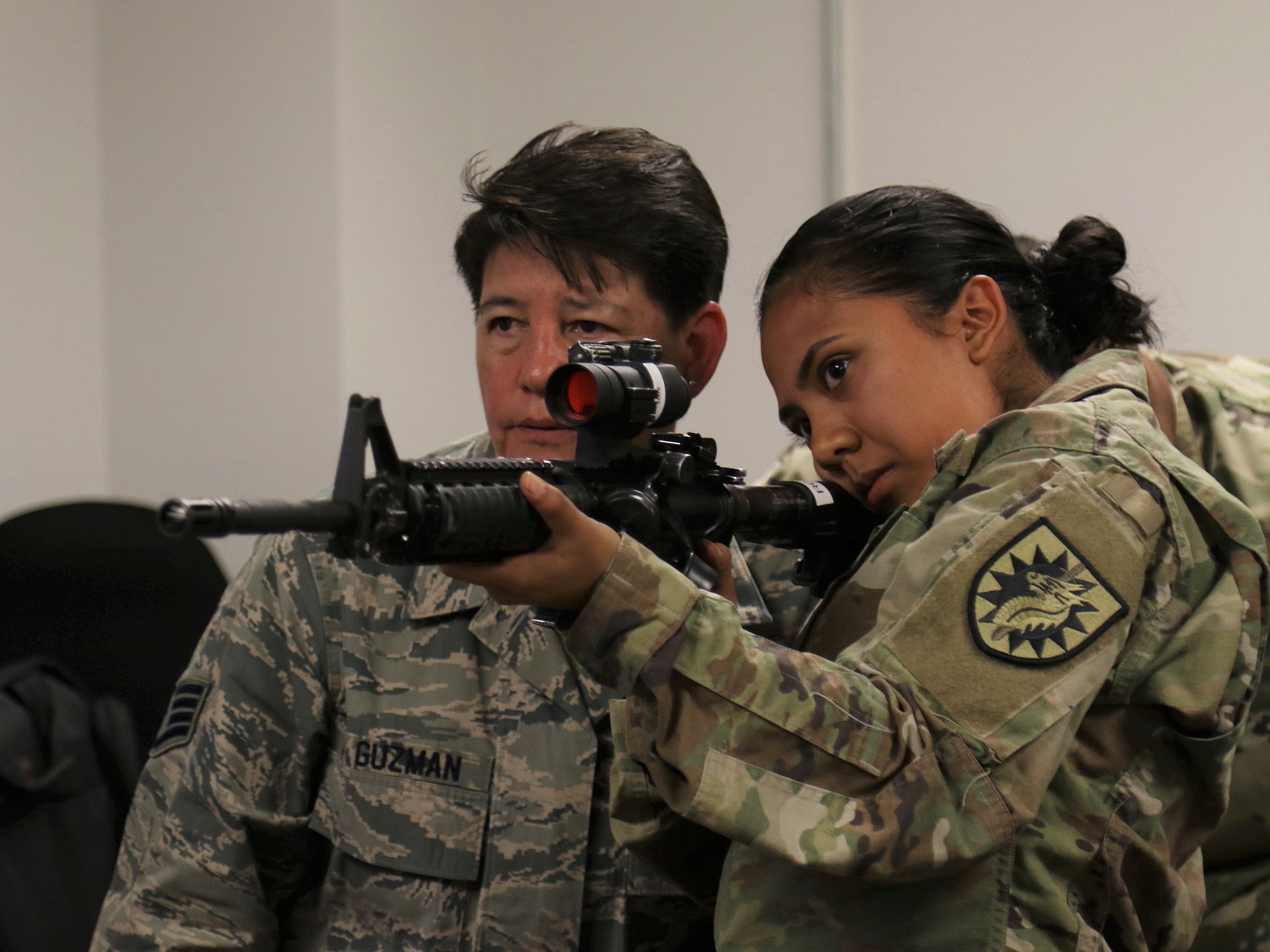
SDFs are distinct from their state’s National Guard in that they cannot become federal entities. All state National Guard personnel (to include the National Guard of the District of Columbia, the Commonwealth of Puerto Rico and the territories of Guam and the Virgin Islands) can be federalised under the National Defence Act Amendments of 1933 with the creation of the National Guard of the United States. This provides the basis for integrating units and personnel of the Army National Guard into the US Army and, since 1947, units and personnel of the Air National Guard into the US Air Force.
The federal government recognises SDFs, as per the Compact Clause of the US Constitution, under 32 U.S.C. § 109 which provides that SDFs as a whole may not be called, ordered, or drafted into the armed forces of the United States, thus preserving their separation from the National Guard. However, under the same law, individual members serving in the SDF are not exempt from service in the armed forces (i.e. they are not excluded from the draft). Under 32 USC § 109(e):
“A person may not become a member of a defense force … if he is a member of a reserve component of the armed forces.”
Nearly every state has laws authorising SDFs, and a range of states (including the Commonwealth of Puerto Rico) have active forces with different levels of activity, support, and strength. SDFs generally operate with emergency management and homeland security missions. Most SDFs are organised as ground units, but air and naval units also exist. Depending on the state, they may be variously named as state military, state military force, state guard, state militia, or state military reserve.
Brief History
Origins
From its founding until the early 1900s, the United States maintained only a minimal army and relied on state militias to supply the majority of its troops, with the training and readiness of the latter varying widely. As a result of the Spanish-American War and the performance of the militias and other volunteer units during that conflict, Congress was called upon to reform and regulate the training and qualification of state militias. In 1903, with passage of the Militia Act of 1903, the predecessor to the modern-day National Guard was formed. It required the states to divide their militias into two sections. The law recommended the title “National Guard” for the first section, for federal administration, and “Reserve Militia” for the individual states.
World War I
During World War I, Congress authorised the states to maintain Home Guards, which were reserve forces outside the National Guard forces that were then being deployed by the Federal Government as part of the National Army. The Secretary of War was authorised to furnish these Home Guard units with rifles, ammunition, and supplies.
Interwar Years
In 1933, Congress finalised the split between the National Guard and the traditional state militias by mandating that all federally funded soldiers take a dual enlistment/commission and thus enter both the state National Guard and the newly created National Guard of the United States, a federal reserve force.
World War II
In 1940, with the onset of World War II and as a result of its federalizing the National Guard, Congress amended the National Defence Act of 1916, and authorised the states to maintain “military forces other than National Guard.”
Cold War
In 1950, with the outbreak of the Korean War and at the urging of the National Guard, Congress reauthorised the separate state military forces for a time period of two years. These state military forces were authorised military training at federal expense, as well as “arms, ammunition, clothing, and equipment,” as deemed necessary by the Secretary of the Army. At the end of the two years, however, they were not reauthorised under federal law.
In 1956, Congress finally revised the law and authorised “state defense forces” permanently under Title 32, Section 109, of the United States Code. Two years later, Congress amended the law and changed the name from “State defense forces” to “defense forces.” Still, it was not until the early Ronald Reagan administration that many states developed their defence forces into elements that existed beyond paper, when the US Department of Defence actively encouraged states to create and maintain SDF units.
By the late 1980s, however, a series of high-profile reports caused several states to shut down or significantly restructure their forces. In 1987, the governor of Utah removed all but 31 officers from the Utah State Guard, after a probe revealed that its ranks were “peppered with neo-Nazis, felons and mental patients.” Meanwhile, in 1990, the Virginia General Assembly launched an investigation and subsequent overhaul of its state’s force after receiving tips that the volunteers were “saving money to buy a tank.”
Contemporary
With the end of the Cold War came a general decrease of interest in SDFs. The September 11 attacks, however, generated additional attention and, with it, greater scrutiny from some in the US military who questioned the training and equipment of the units and whether they provided an outlet for “warrior wannabes” who would not otherwise qualify for service in the armed forces.
In 2008, Alaska disarmed its SDF after an investigation concluded the lack of training intensity or standardisation was a potential legal liability to the state. By 2010 the status of the force had been downgraded even further, with the Adjutant-General of the Alaska National Guard informing volunteers that they would only be called upon as a “reserve of last resort to be used only in the most extreme emergencies.” The ASDF remained deliberately hamstrung for several years, until Governor Bill Walker overruled the Adjutant-General in 2016 when he announced his intention to reform the Alaska SDF by expanding it further into rural Alaska and improving training standards.
Further controversy was stoked by a New York Times report which found many senior officers in the New York Guard had little or no formal military training despite holding, in some cases, general officer ranks. The former commander of the force, Pierre David Lax, noted that, “if you are friendly with the governor and you always wanted to be a general, you ask the governor to make you a general, and poof, you are a brigadier general.” Another former commander asserted he regularly awarded titles to members of the New York legislature in exchange for their support of budgetary allocations to the force. The report also noted that a majority of the unit’s rare deployments involved providing ceremonial support, such as bands and colour guards, to the state government.
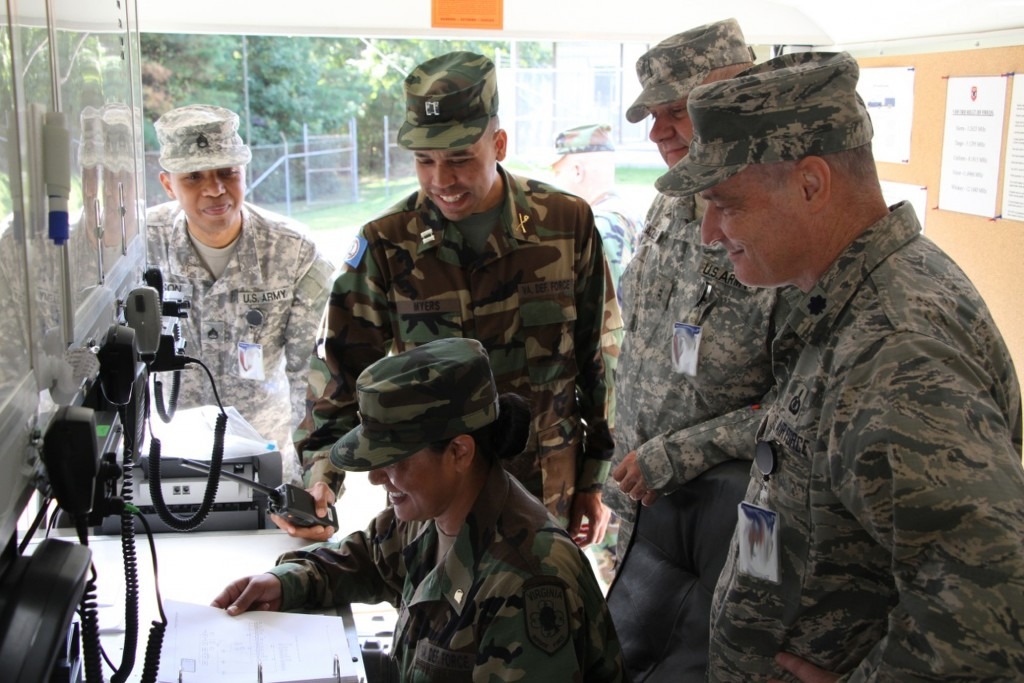
An April 2014 Department of Defence report by the Inspector General’s office reported confusion and inconsistency among state adjutant generals as to the use and status of SDFs. The Inspector General’s office reported an under-utilisation of SDF capabilities due to a lack of clarity in the US Code regarding the use of SDFs, fuelling fear that using funds and assets acquired through the federal government for SDFs could run afoul of regulations. (While the National Guard is operated by the states, most of their equipment and funding comes from the federal government.) This fear of violating regulations also inhibited their use and integration with their National Guard counterparts, preventing them from conducting joint operations alongside one another, and also from volunteering in support of federal missions. Other problems cited by the Inspector General’s office were a lack of standardisation in training and physical fitness, raising questions as to the ability of SDFs to work alongside their National Guard counterparts, and a lack of coordination with and support from the Department of Defence. During a survey conducted by the Inspector General of SDF commanders and adjutant generals, 18 of 19 considered their SDFs to be part of the organised militia and subject to the Code of Military Justice, 14 of 18 considered the members of SDFs to be “soldiers”, 14 of 18 considered SDF personnel to be “lawful belligerents” under the rules of war, and only 4 of 19 authorised their personnel to conduct firearms training. Almost all of the missions reported to the IG’s office were non-military in nature, including small-scale search and rescue, disaster management, and other unarmed, homeland security related-tasks.
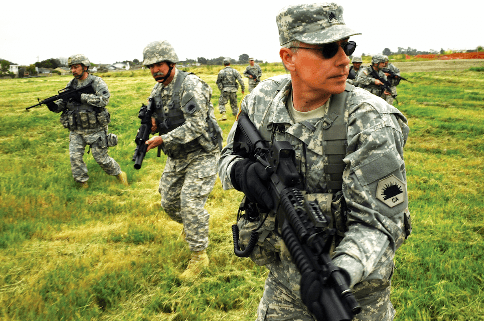
Due to public fears over the Jade Helm 15 exercises held throughout a number of southwestern states, on 28 April 2015, Governor Greg Abbott of Texas ordered a call-up of the Texas State Guard to monitor the exercises and facilitate communication between US special operations forces conducting training and the governor’s office.
In early 2020, a number of SDFs were activated to combat the COVID-19 pandemic. As of April 2020, the Alaska SDF, the California State Guard, the Governor’s Guards of Connecticut, the Georgia SDF, the Indiana Guard Reserve, the Maryland Defence Force, the New York Guard, the Ohio Military Reserve, the South Carolina State Guard, the Tennessee State Guard, the Texas State Guard, and the Virginia Defence Force had all contributed members to their respective states’ efforts in combating the pandemic.
Future
A 2003 article in the United States Army War College’s Parameters journal recommended that “United States Northern Command (NORTHCOM) should ensure that future contingency planning efforts for homeland security operations fully incorporate the valuable capabilities that State Defense Forces can provide.” In the decade following that article, however, no significant action has been taken on the recommendation.
Several bills have been unsuccessfully introduced in Congress since the early 1990s seeking to improve the readiness of SDFs. The most recent, H.R. 206, introduced in 2009 by Rep. Joe Wilson of South Carolina, would have allowed the US Secretary of Defence to transfer surplus US military equipment to SDFs. Co-sponsors of the bill included Jim Marshall and Frank Wolf. Congress took no action on the measure before adjourning.
In recent years, SDFs have focused on retooling their capabilities to be better prepared for future missions by improving their professionalism and interoperability with other agencies. The development of professional commands to support the National Guard, especially medical commands to buttress civil authorities during a civil crisis, has become an emerging trend.
Several SDFs have begun to shift their focus to preparing for larger emergencies which may require multiple states to coordinate relief efforts. In July 2015, the Virginia Defence Force headed a multi-state communications exercise, the first ever of its kind, where the VDF practiced long-distance radio communications with the Tennessee State Guard, Indiana Guard Reserve, Texas State Guard, and the California State Military Reserve. Further efforts at standardising training between SDFs by setting competency requirements have been undertaken by the State Guard Association, which followed its Military Emergency Management Specialist training programme with a JAG Academy an Engineer Specialty Qualification Badge, and plans for a Medical Academy in the future.
Individual states have made efforts to increase their capabilities to be prepared to take on future missions. In March 2017, the California State Military Reserve activated its Maritime Component to lead and assist in future homeland security missions while working in conjunction with other agencies, including the Coast Guard Auxiliary, the California Department of Fish and Wildlife, CalTrans, and other civilian departments. As of May 2017, the Maryland Defence Force has significantly reorganized; the number of available officer billets has been shrunk, and the job descriptions reorganized, in order to avoid having a top-heavy organisational structure. New units, including the Maryland Emergency Management Agency (MEMA) Support Unit, have been approved, and others, such as the MDDF Cyber Unit, have planned expansions. Training standards were also heightened, with the MDDF requiring that drill participation, age, height, and weight requirements be more strictly enforced. Further, all new soldiers are currently required to earn their Military Emergency Management Specialist Badge. These changes were made with the goal that the future MDDF would be able to “seamlessly integrate into missions with the National Guard.”
List of State Defence Forces
There are currently 20 active SDFs. The Puerto Rico State Guard includes an air support component, the 1st Air Base Group, that support the operations of the Puerto Rico Air National Guard.
| State or Territory | Status | Ground or Air Division | Naval Division | Air Wing | Weapons Training |
|---|---|---|---|---|---|
| Alabama | Inactive | Alabama State Defence Force | Not currently | ||
| Alaska | Active | Alaska State Defence Force | Alaska Naval Militia | Yes | |
| American Samoa | Not authorised under Title 32 | ||||
| Arizona | Inactive | Arizona State Guard | |||
| Arkansas | Inactive | Arkansas State Guard | |||
| California | Active | California State Guard | Cal Guard Maritime | Yes | Yes |
| Colorado | Inactive (Colorado does not operate an active SDF, but rather has a statutory SDF staffed by one individual appointed by the governor.) | Colorado State Defence Force | |||
| Connecticut | Ceremonial | Connecticut State Militia Units | Connecticut Naval Militia (Inactive) | Yes | |
| Delaware | Inactive | Delaware State Guard | |||
| District of Columbia | Not Established | District of Columbia Reserve Corps | District of Columbia Naval Battalion | ||
| Florida | Active | Florida State Guard | Florida Naval Militia (Inactive) | ||
| Georgia | Active | Georgia State Defence Force | Georgia Naval Militia (Inactive) | Yes | |
| Guam | Inactive | Guam Militia | |||
| Hawai’i | Inactive | Hawaii Territorial Guard | |||
| Idaho | Inactive | Idaho State Guard | |||
| Illinois | Inactive | Illinois State Guard | Illinois Naval Militia | Not currently | |
| Indiana | Active | Indiana Reserve Guard | Indiana Naval Militia (Inactive) | Yes | |
| Iowa | Inactive | Iowa State Guard | |||
| Kansas | Inactive | Kansas State Guard | |||
| Kentucky | Inactive | Kentucky Active Militia | |||
| Louisiana | Active | Louisiana State Guard | |||
| Maine | Active | Maine State Guard | |||
| Maryland | Active | Maryland Defence Force | Maryland Naval Militia (Inactive) | Not currently | |
| Massachusetts | Inactive | Massachusetts State Defence Force | Massachusetts Naval Militia | Not currently | |
| Massachusetts | Ceremonial | National Lancers | |||
| Michigan | Active | Michigan Defence Force | |||
| Minnesota | Inactive | Minnesota State Guard | Minnesota Naval Militia (Inactive) | ||
| Mississippi | Active | Mississippi State Guard | Simulated only | ||
| Missouri | Inactive | Missouri State Defence Force | |||
| Montana | Not established | ||||
| Nebraska | Inactive | Nebraska State Guard | |||
| Nevada | Not established | ||||
| New Hampshire | Inactive | New Hampshire State Guard | |||
| New Jersey | Inactive | New Jersey State Guard | New Jersey Naval Militia | ||
| New Mexico | Active | New Mexico State Defence Force | |||
| New York | Active | New York Guard | New York Naval Militia | ||
| North Carolina | Inactive | North Carolina State Defence Militia | North Carolina Naval Militia | ||
| North Dakota | Not established | ||||
| Northern Mariana Islands | Not authorised under Title 32 | ||||
| Ohio | Active | Ohio Military Reserve | Ohio Naval Militia | Honour Guard Currently | |
| Oklahoma | Inactive | Oklahoma State Guard | |||
| Oregon | Active | Oregon Civil Defence Force | |||
| Pennsylvania | Inactive | Pennsylvania State Guard | |||
| Puerto Rico | Active | Puerto Rico State Guard | Yes | Yes | |
| Rhode Island | Inactive | Rhode Island State Guard | Rhode Island Naval Militia | ||
| Rhode Island | Ceremonial | Rhode Island Independent Military Organisations | Providence Naval Battalion (Inactive) | ||
| South Carolina | Active | South Carolina State Guard | South Carolina Naval Militia | Yes | |
| South Dakota | Inactive | South Dakota State Guard | |||
| Tennessee | Active | Tennessee State Guard | Range qualification for military police | ||
| Texas | Active | Texas State Guard | No | Yes (some units) | |
| US Virgin Islands | Not established | ||||
| Utah | Inactive | Utah State Defence Force | |||
| Vermont | Active | Vermont State Guard | Yes | Competitive only | |
| Virginia | Active | Virginia Defence Force | VDF Riverine Detachment Unit (Disbanded) | Inactive | No |
| Washington | Active | Washington State Guard | Not currently | ||
| West Virginia | Not established | ||||
| Wisconsin | Inactive | Wisconsin State Defence Force | Wisconsin Naval Militia | ||
| Wyoming | Not established |
Structure
Personnel and Training
Some SDFs advertise recruitment and physical standards lower than the US military with relaxed waiver standards. While other SDFs, and specific units, advertise professional military and physical fitness standards to retain integration with National Guard counterparts and more physically demanding state and interagency missions.
California, for instance, requires no physical fitness test prior to entry and has weight/height standards significantly more relaxed than the federal service for certain units, but require passing an arduous physical fitness test, pack hikes, and comprehensive tryouts for certain jobs like firefighters, search and rescue, and certain maritime search and rescue/dive personnel within the Cal Guard’s Emergency Response Command and Maritime Service. California State Guard wildland firefighters, for example, must complete the National Wildfire Coordinating Group Red Card standards, then complete a rigorous Cal Fire interagency training programme alongside their National Guard counterparts. In the Texas State Guard, there are minimal requirements for general accession, but joining specialised teams like the Dive, Rescue, and Recovery (DR&R) Team requires comprehensive physical fitness testing and completion of the Texas Dive School.
Officer Candidate Schools are also maintained by the active SDFs of the United States by direction of their respective state military departments and by the state’s National Guard Adjutant General. Similar to their state’s National Guard counterparts who take a dual federal and state military commission, military officers who are commissioned through a SDF Officer Candidate School take a sole military commission to the state that they support, recognised by their state’s military code and 32 U.S.C. § 109. In states with full integration of state military resources (SDF and National Guard counterparts) the curriculum is often similar, with the National Guard curriculum taking on additional requirements to meet federal recognition (referred to as FEDREC). For example, California maintains both Officer Candidate Schools at Camp San Luis Obispo, with the State Guard OCS being 11-12 months and the National Guard OCS being 16-18 months, both celebrate a joint graduation.
The Military Emergency Management Specialist Badge, created by the State Guard Association of the United States, has become a common training focal point among SDFs. Alabama, California, Indiana, Ohio and others have adopted the MEMS Badge as a basic qualification required of all members desiring promotion. Training is conducted both online, and through MEMS academies in each state, and includes course material provided by FEMA and other agencies, as well as practical experience in local disaster planning and exercise management.
Community Emergency Response Teams (CERTs) are being organised by several SDFs by utilising training offered by the Federal Emergency Management Agency’s (FEMA’s) Citizen Corps. Some states follow the lead of the Army and offer a permanent tab (worn in a similar manner as the Army’s Ranger and Sapper tabs) as an incentive to become certified as part of the local or unit CERT team.
SDFs may incorporate Medical Reserve Corps units into their organisational structure. The 47th Medical Company (MRC), of the New Mexico SDF, the 10th Medical Regiment of the Maryland Defence Force, and the Medical Brigade of the Texas State Guard receive training and recognition from the Medical Reserve Corps programme sponsored by the Office of the Surgeon General of the United States through the Citizen Corps programme, and are simultaneously organised as units of their respective SDF.
Weapons qualification and training is provided in some SDFs. However, most SDFs do not require weapons proficiency. A 2006 report by the US Freedom Foundation, an organisation affiliated with the State Guard Association of the United States, recommended minimum standards for SDFs, including weapons training, but the report has been largely ignored. Some SDFs have laws that in the event of deployment by order of the state legislature and/or governor, they will become armed.
Uniforms

As a general rule, SDFs wear standard US military uniforms with insignia closely matching those of their federal counterparts. SDF units generally wear red name tags on service uniforms (as specifically prescribed by AR 670-1 for SDF units when adopting the Army Service Uniform or Battle Dress Uniform (BDU), and name tapes on Army Combat Uniform (ACU) or BDU uniforms use the SDF name or state name rather than “U.S. Army.” Standard US Army branch insignia are often used or a unique “state guard” branch insignia consisting of a crossed musket and sword is alternatively used.
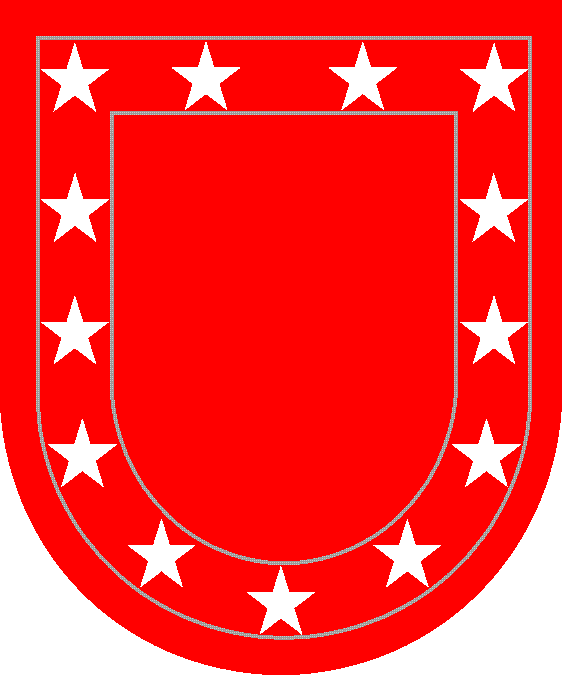
Where berets are worn, some SDFs use a beret flash similar to the one the US Army uses, but in bright red thread instead of the Army’s blue. Other states have beret flashes that are often based on their state flag.
Uniforms vary from state to state and tend to have only subtle differences. For example, the Texas State Guard wears standard US Army camouflage uniforms, a state guard unit patch, and the “U.S. Army” name tape replaced with one reading “Texas State Guard.” Similarly, the California State Military Reserve wears a uniform identical to their National Guard counterparts except for the unit patch, beret flash, and the “California” name tape. Outer garments such as a Gore-Tex jacket have a subdued “CA” beneath the rank insignia. A similar pattern can be found in the New York Guard. The Georgia State Defence Force often works in tandem with and support of federal troops. The Georgia SDF wears the OCP pattern of the ACU with a unique Georgia SDF red flash on the US Army’s black beret and “Georgia” in place of the “U.S. Army” uniform name tape. The Tennessee State Guard and Alabama SDF can wear either BDU’s or the “tactical response uniform” (TRU) in the Woodland pattern but whose cut and accoutrements match the ACU but cannot mix pieces. The Alabama SDF has also recently introduced a new “Standard Service Uniform” composed of a blue tactical shirt, and khaki tactical pants.
The few states with both SDF air and naval units wear modified USAF and USN/USMC uniforms. Currently, only Ohio, Alaska and New York have uniformed naval militias. Only California, Vermont, and Puerto Rico have an air wing, though Indiana formerly had an Air Guard Reserve. In all cases, the state adjutant general has final say on uniforms worn by SDFs, though federal service regulations generally shape the policies of each state.
Special Units
SDFs include a variety of special units including medical, aviation, and ceremonial units. The following are examples:
- Cyber Security Command, Maryland Defence Force
- Cavalry Troop A, Maryland Defence Force
- 121st Engineer Regiment, Maryland Defence Force
- 10th Medical Regiment, Maryland Defence Force
- 61st Medical Company, Tennessee State Guard
- Finance Corps, Maryland Defence Force
- Judge Advocate Corps, Maryland Defence Force
- Maryland Defence Force Band
- Governor’s Foot Guard, Governor’s Horse Guard & Band, Connecticut State Militia
- 1st Medical Company, Georgia SDF
- 1st Platoon – DECON/CBRN-e
- Quick Reaction Teams (QRT) (now disbanded) – Small units attached to a number of Texas State Guard Civil Affairs (CA) regiments. QRT undergo specialised training and qualify with approved NATO 9mm sidearm. QRT compete in the Governor’s Twenty competition with the Texas Army National Guard and Texas Air National Guard.
- Small Arms Training Team – Small arms and crew served weapons team of the California State Military Reserve
- Search and Rescue Company, Puerto Rico State Guard
- The 1st Air Base Group, Puerto Rico Air State Guard
- The Georgia SDF OPFOR unit
- RAIDER School, South Carolina State Guard
- 143rd CSMR Support Battalion, State MP Unit, California State Military Reserve.
Federal Activation
The US Constitution, coupled with several statutes and cases, details the relationship of SDFs to the federal government. Outside of 32 U.S.C. 109, the US Supreme Court noted: “It is true that the state defense forces ‘may not be called, ordered, or drafted into the armed forces.’ 32 U.S.C. 109(c). It is nonetheless possible that they are subject to call under 10 U.S.C. 331–333, which distinguish the ‘militia’ from the ‘armed forces,’ and which appear to subject all portions of the ‘militia’ – organized or not – to call if needed for the purposes specified in the Militia Clauses” (Perpich v. Department of Defence, 496 U.S. 334 (1990)).a The Court, however, explicitly noted that it was not deciding this issue. The following is an extract of the laws which the Court cited as possibly giving the federal government authority to activate the SDFs:
10 U.S.C. 251 – “Federal aid for State governments”
Whenever there is an insurrection in any State against its government, the President may, upon the request of its legislature or of its governor if the legislature cannot be convened, call into Federal service such of the militia of the other States, in the number requested by that State, and use such of the armed forces, as he considers necessary to suppress the insurrection.
10 U.S.C. 252 – “Use of militia and armed forces to enforce Federal authority”
Whenever the President considers that unlawful obstructions, combinations, or assemblages, or rebellion against the authority of the United States, make it impracticable to enforce the laws of the United States in any State or Territory by the ordinary course of judicial proceedings, he may call into Federal service such of the militia of any State, and use such of the armed forces, as he considers necessary to enforce those laws or to suppress the rebellion.
10 U.S.C. 253 – “Interference with State and Federal law”
The President, by using the militia or the armed forces, or both, or by any other means, shall take such measures as he considers necessary to suppress, in a State, any insurrection, domestic violence, unlawful combination, or conspiracy, if it –
(1) so hinders the execution of the laws of that State, and of the United States within the State, that any part or class of its people is deprived of a right, privilege, immunity, or protection named in the Constitution and secured by law, and the constituted authorities of that State are unable, fail, or refuse to protect that right, privilege, or immunity, or to give that protection; or
(2) opposes or obstructs the execution of the laws of the United States or impedes the course of justice under those laws.
In any situation covered by clause (1), the State shall be considered to have denied the equal protection of the laws secured by the Constitution.
SDF Reactivation Efforts
A number of legislators have spearheaded attempts to reactivate the SDFs of their states. In 2011, a bill was introduced in the New Hampshire General Court which, if passed, would permanently re-establish the New Hampshire State Guard. The bill did not pass. The same year, Governor Jan Brewer signed a bill which authorised the organisation of a SDF in Arizona. In 2018, Kansas state senator Dennis Pyle petitioned the Governor of Kansas to reactivate the Kansas State Guard, in part to offer an additional security resource for schools.
In 2019, Pennsylvania State Representative Chris Rabb proposed legislation which would reactivate and modernise the Pennsylvania State Guard in order to “address the epidemic of gun violence, domestic terrorism, and other inter-related public health crises.”
In December 2021, Florida Governor Ron DeSantis announced plans to re-establish the Florida State Guard as a 200-person volunteer force that would act independently of the federal government in disaster relief efforts. The reactivated Florida State Guard was announced in June 2022.
In January 2022, Oklahoma State Senator Nathan Dahm introduced legislation to reactivate the Oklahoma State Guard. The bill failed in the Republican-led Oklahoma Senate Veterans Committee in February 2022.
Notable Members
- Radio host Clark Howard retired from the Georgia SDF after more than 20 years of service.
- Former New York state Republican Party chairman Joseph Mondello was a member of the New York Guard.
- David P. Weber, former Assistant Inspector General of the US Securities and Exchange Commission and whistleblower, is a Lieutenant Colonel JAG officer in the Maryland Defence Force, attached to the Maryland Army National Guard.
- Lauren Guzman, who was crowned Miss Texas USA in 2014, is a member of the Texas State Guard.
- Cooper Hefner, Son of Hugh Hefner, was a member of the California State Guard.
- Alvin C. York, one of the most decorated US Army soldiers of World War I, served in the Tennessee State Guard.
- Former Heavyweight champion boxer Lieutenant Jack Dempsey served in the New York Guard.
This page is based on the copyrighted Wikipedia article < https://en.wikipedia.org/wiki/State_defense_force >; it is used under the Creative Commons Attribution-ShareAlike 3.0 Unported License (CC-BY-SA). You may redistribute it, verbatim or modified, providing that you comply with the terms of the CC-BY-SA.


 Boot Camp & Military Fitness Institute
One thought on “What is a State Defence Force?”